
“The only thing new in the world is the history you do not know.”
― Harry S. Truman
Isn’t it funny how as you get older, you remember things from many years ago? I am sure my extended time in the hospital, the time to recover, and the (wonderful!) pain medications all had something to do with it. Lots of time to think as the nurses make their rounds every two hours to wake you up to poke and prod.
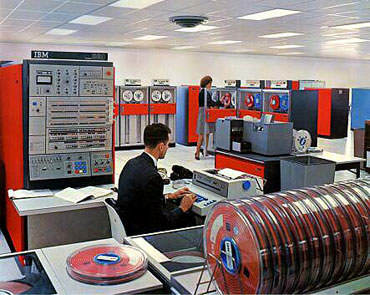
In the mid-to-late 80’s I was working for what was then the worlds second-largest computer company. I had an awesome opportunity to work with a team of professionals to build a global computer services business. Back then we called it computer timesharing. That industry started back when computers were HUGE, very expensive, and had about 1/100th (1000th?) of the power of the Smartphone you have today. NASA, governments, and very large corporations used these behemoths to run their operations. I know, because to pay for college, I was a third shift computer operator for a major university on an IBM 360/50. Quite an experience watching blinking lights, punching 80 column cards for computer programs, and knowing my work made the university run.
Zero core (reset the computer memory) and re-IPL (reinstall the Initial Program Load) is what you would do to the mainframe computer to turn it off and restart it. Today we might say “Is it plugged in? Is it turned on?” or even “turn it off, and turn it on, again…”
But I digress. For giant companies like McDonnell Douglas, General Electric, and United Telecom (now Sprint) they started computer timesharing businesses to allow people who could not afford these computers to share compute time on them – hence, computer time-sharing. Other computer timesharing companies like Tymshare were formed as well to provide access on a pay-as-you-go basis and were very successful. These computers were accessed through computer networks. Some had dial-in network access to the computers and some had dedicated network access. Special software was installed for the user to use. The users were charged only for the time they used the computer, networks, and software.
My role was to work with my team and build-out seven data centers and develop a profitable go to market business and operating plan. Complete with raised floors for cooling, uninterruptable power supplies with multiple power grids, multiple telecom networks, operating and disaster recovery procedures… Well, you get the idea. Building an entirely new business with seven new data centers to allow people to use computing power and pay only for what they use. In the end, I led the creation of this computer services (timesharing) business for my company. The key never was just to build and operate seven data centers. It was how to build a profitable business that would deliver value to our customers. In the end, it was very successful and part of the skills and experience I have brought with me throughout the years. Amazing what you remember…
It occurred to me that over 30 years later, we call that same business concept: cloud computing.
Who remembers artificial intelligence: the concept of having a computer learn? By pumping massive amounts of data into a computer, writing very sophisticated software algorithms, and discovering new opportunities in the massive complex data was a truly exciting time.
After a lot of time to think, it occurred to me that today, almost 30 years later, we call that same business concept: business analytics. Today we have the Internet of Things ( or the Internet of Everything or even Digitization) that is driving business analytics.
Sure, I get it. Economics and technologies are very different today. Computing power and network access are widely available, small in size, and comparably very easy to use. But in the end it winds up being the same, but different. It seems to me we must learn from experience and combine it with a vision of the future to make the value of these approaches real for today.
In the technology industry, as with many industries, the company that is agile and masters disruption, finds the “next wave”, introduces the next new product, capture a new market, etc. is the one that will be rewarded by the market. Executives that have respect for those who have experience with past business models similar to new trends will have a competitive advantage leveraging disruption to their own competitive advantage.

 Global Navigator